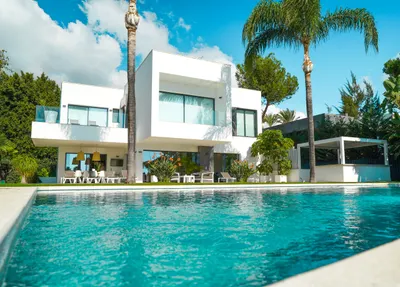
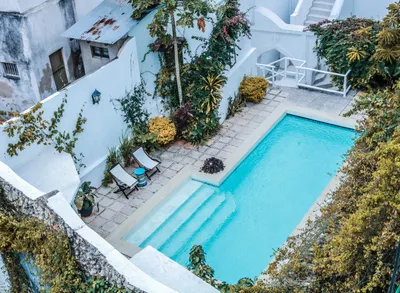
A 3D tour is a recording of a property on one particular morning. Whatever the scanner sees on that pass is what a buyer, a guest or an event planner will see for the next year. Furniture can be moved before the appointment. Light cannot.
Most owners on the Costa del Sol book a scan around their own diary: the slot that suits the agent, the day the cleaner comes, the afternoon the tenant is out. That is understandable, and it is usually the wrong way round. The hour you choose changes the finished tour more than almost any other decision you make.
The same villa can look like two different properties
Scan a south-facing villa in Nueva Andalucía at eleven in the morning and the terrace is a white rectangle. The sea behind it has gone. The camera has exposed for the room, so the doorway reads as a hole cut in the wall.
Scan the same villa at half past five and the terrace has depth again. The tiles are there, the loungers are there, the coastline is there. Nothing about the property changed. The tour is a different product.
This coast sharpens the effect. The light is hard for most of the year, the walls are white or pale, and the floors are polished marble or large-format porcelain. Together those turn every opening into a light source the camera has to work against, and every floor into a mirror.
What actually changes through the day
Rooms that open to the sea
South and south-west facing rooms decide the tour, because they are the rooms people came to see. Around midday the sun sits high and slightly behind the building, so the terrace outside is far brighter than the room inside. A scanner handles that gap by choosing: either the room goes dark or the view goes white. Later in the afternoon the outside brightness falls, the gap narrows, and both survive in the same panorama.
Rooms with no exterior wall
Interior bathrooms, dressing rooms, cinema rooms and basement gyms do not care what time it is. They are lit by whatever fittings you switch on. These are the rooms to walk through the evening before, replacing dead bulbs and matching colour temperature, because a room where one downlight is warm and three are cold looks broken in a tour even when it looks fine to your eye standing in it.
Glass, water and marble
Pools, glass balustrades, shower screens and polished floors all return the sun straight back at the camera. Low sun does this worst, and it does it as a hard streak across the middle of a panorama rather than as a general brightness. On a property where the pool sits between the house and the view, an early or late slot can put a reflection in the frame that no amount of processing removes.
Choosing the slot
A villa with terraces and a pool
Mid to late afternoon, ending before the sun drops low enough to sit in the pool. The terrace and the interior are close enough in brightness to hold together, and the low-sun reflection problem has not started yet. In high summer that window is later than owners expect.
An apartment in a mid-rise block
Follow the aspect rather than the clock. A west-facing apartment scans well in the morning, when its own windows are in shade and the interior is lit evenly. An east-facing apartment scans well after lunch, for the same reason reversed. The rule is simple: scan a room when the sun is not pointing into it.
A venue, a restaurant or a hotel with evening trade
Scan the daytime state and the evening state as two separate passes if the space genuinely sells both. A wedding venue in the Serranía de Ronda is booked on how it looks at seven in the evening, and a single midday scan will never show that. Two passes cost more than one. Deciding after the fact that you needed both costs a return visit.
The hour before the scanner arrives
Light is the part you book. There is a short list you control on the day:
- Open every blind and curtain to the same position. Half-open blinds in one room and full-open in the next reads as inconsistency across the tour, not as a styling choice.
- Switch every light on, including lamps, and leave them on for the whole pass. Mixed states between panoramas are visible.
- Clean the glass that faces the sun. Dust on a balustrade is invisible until it is backlit, and then it is all you can see.
- Move cars off the drive and covers off the pool. Both are cheap to do and expensive to fix later.
- Decide where the tour should start. The entrance is the honest choice; the terrace is the flattering one. Pick before, not during.
Why the timing is worth planning around
A photographic shoot that goes badly can be reshot for the cost of a morning, and the weak frames simply never get used. A 3D tour does not work that way. It is one continuous model of the whole property, so a badly lit terrace is not one bad photograph you quietly drop. It is a room inside the model, and every visitor walks through it.
The tour is also the asset with the longest life. A listing photograph is looked at for a few seconds. A tour stays embedded on the listing, in the brochure link and in the message you send to an enquiry, for as long as the property is on the market or the venue is taking bookings. Booking the right two hours is a small change to your diary that the tour carries for its whole working life.
If you are not sure which slot your property wants
Aspect, floor level, pool position and what the property is being sold on all feed into it, and the answer for a Marbella penthouse is not the answer for a cortijo outside Ronda. We will look at the property and tell you which window to book before anything is scheduled.
→ Tell us about your property and we will recommend a slot